
Department of Pharmacology, Institute of Pharmaceutical Reseach, GLA University, Mathura, Uttar Pradesh, India
*Corresponding author: Rishabh Gaur
Assistant Professor, Department of Pharmacology, Institute of Pharmaceutical
Reseach, GLA University, Mathura, Uttar Pradesh, India.
Email ID: rgaur7089@gmail.com
Tel: +91-8279776188
Received: Dec 23, 2024
Accepted: Jan 13, 2025
Published Online: Jan 20, 2025
Journal: Annals of Traditional Chinese Medicine
Copyright: Gaur R et al. © All rights are reserved
Citation: Gaur R, Sharma Y. Botanical, phytochemical and pharmacological aspects of Prunus Serrulata: A traditional medicinal plant of China. Ann Tradit Chin Med. 2025; 2(1): 1004.
In Traditional Chinese Medicine (TCM), Prunus serrulata (P. serrulata) has a long history of use as a medicinal herb. This review aims to provide an updated overview of the phytochemical constituents and pharmacological attributes P. serrulata. A thorough search of scientific databases, such as Web of Science, PubMed, and Scopus, was done in order to find pertinent research up to September 2023. It was discovered that P. serrulata contains a wide range of phytochemical elements, with the two most notable bioactive substances being Flavonoids, alkaloids, and terpenoids were also present. Numerous pharmacological activities, such as antioxidant, anti-cancer, and antiviral properties, have been established by these substances. Furthermore, P. serrulata has been studied for its ability to treat a variety of illnesses, including cancer, heart problems, and neurological issues. P. serrulata highlights the continued need for scientific research and clinical evaluation by offering a compelling path for potential medicinal development.
Keywords: Prunus serrulate; Pharmacological activities; Antiviral; Flavonoids; Antioxidant.
Cherry blossoms, which belong to the genus Prunus or the Prunus subgenus Cerasus, are also referred to as Japanese cherries or sakuras. The Northern Hemisphere is home to the majority of the world’s wild cherry tree species [1-6], being common in East Asia, especially in China and Japan. They are generally refer as to ornamental cherry trees, not cherry trees grown for their fruit [7,8]. The cherry blossom is considered the national flower of Japan, This serves as a source of inspiration for the Japanese people. India was added to the Sakura Map as the 28th nation worldwide. Collingwood Ingram gathered and researched Japanese cherry blossoms in Europe during the late 19th and early 20th centuries, creating a variety of attractive varieties. Pretty quickly, ornamental cherry blossom culture started to expand. Ornamental cherry blossoms first appeared in the United States in 1912, when Japan gave them to the country as a friendship gift [9,10]. Cherry trees grown for ornamental reasons in Europe and North America are categorized under the genus Prunus, which has over 400 species. However, decorative cherry trees are categorised in the genus Cerasus in the mainstream taxonomy used in China, Japan, and Russia. This genus has roughly 100 species that have been split off from the genus Prunus [7]. Cherry trees, called yinghua (櫻花) in Chinese, are native to the central and southern regions of the country. Japan diplomatic delegations returned with cherry blossoms from China during the Tang Dynasty.
Watching plum blossoms has long been a traditional pastime in mainland China. Cherry blossoms were seen in numerous wild species, however many of them had little flowers. The range of wild cherry blossom species that produced large enough flowers for hanami was frequently restricted to the areas surrounding densely inhabited areas [11,12]. Manipur scientists have discovered a new species of “cherry blossom,” which they have called Prunus dinabandhuana in honour of scientist Dr. Dinabandhu Sahoo and in recognition of his remarkable accomplishments [15].
Additionally, there are numerous varieties (a sub classification of species), hybrids between species, and cultivars of cherry trees because they have a wide range of blossoms and characteristics and are particularly prone to mutation.
This has led to confusion in the classification of these plants as many scholars have given different scientific names to the same variety of cherry tree throughout different time periods [13,14]. Cherry blossom have a many pharmacological action, including antioxidants, anti-inflammatory and anti-ageing, and other properties.
The literature pertaining to publications containing the knowledge surrounding P. serrulata from the year 2000 to September 2023 was searched using Google Scholar, Scopus, PubMed, and Web of Science. Out of the 200 articles that were retrieved, 100 items were taken into consideration. An attempt was made to gather relevant works that focused solely on P. serrulata. Such scientific and molecular data has not yet been published in any publications. This review helps with the creation of the plant monograph in accordance with the Japanese Healthcare System and offers up many new avenues for future studies.
Kingdom: Plantae
Clade: Tracheophytes
Clade: Angiosperms
Clade: Eudicots
Clade: Rosids
Order: Rosales
Family: Rosaceae
Genus: Prunus
Subgenus: Prunus subg. Cerasus
Section: P. sect. Cerasus
Species: P. serrulata
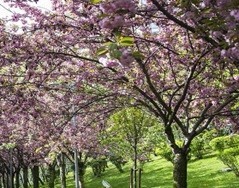
Common name: Japanese flowering cherry or oriental cherry
Synonyms: Paperbark cherry, Tibetan cherry
Habitat: Western Asia and Eastern Europe from the Caspian Sea to the Balkans.
There is a vast array of cherry blossoms (sakura) in Japan. There are more than 200 varieties. Based on one classification scheme, about 600 varieties are believed to exist in Japan. According to the Tokyo Shimbun, there are eight hundred different kinds of cherry blossoms in Japan [16-19]. The Forestry and Forest Products Research Institute in Japan conducted a DNA analysis of 215 cultivars in 2014, and the results showed that many of the cherry tree cultivars that are now widely distributed are interspecific hybrids created by crossing different wild species with Oshima cherry and Prunusu jamasakura (Yamazakura) with various species [26].
Sakura cultivars include the following species, hybrids, and varieties [20-24]:
• Prunus apetala
• Prunus campanulate
• Prunus × furuseana (P. incisa × P. jamasakura [25])
• Prunus × incam (P. incisa × P. campanulata)
• Prunus × sieboldii
• Prunus speciosa
• Prunus × subhirtella (P. incisa × P. itosakura [25]
• Prunus × syodoi
• Prunus × tajimensis
• Prunus × takenakae
• Prunus × yedoensis (P. itosakura × P. speciosa) [25]
• Prunus incisa var. kinkiensis
• Prunus × introrse
• Prunus itosakura (Prunus subhirtella, Prunus pendula)
• Prunus jamasakura [ja]
• Prunus × kanzakura (P. campanulata × P. jamasakura and P. campanulata × P. speciosa) [25]
• Prunus leveilleana (Prunus verecunda)
• Prunus × miyoshii
• Prunus nipponica
• Prunus padus
• Prunus × parvifolia (P. incisa × P. speciosa) [25]
• Prunus pseudocerasus
• Prunus × sacra (P. itosakura × P. jamasakura) [25]
• Prunus sargentii
• Prunus serrulata var. lannesiana, Prunus lannesiana (Prunus Sato-zakura group. Complex interspecific hybrids based on Prunus speciosa. [26])
• Prunus × sieboldii
They have a many uses like: This tree’s edible fruits are used as an emmenagogue and in traditional medicine to treat mastitis, dropsy, and heart failure.
Phytochemical compounds
In this context, the profile of the phytochemical elements in the Prunus genus is particularly interesting. Numerous secondary metabolites, including carotenoids, gibberellins, phenolic acids, terpenes, steroids, phenylpropanoid esters, and flavonoids, are abundant in Prunus species [27-29]. P. serrulata have demonstrated several biological activities, such as anticancer, antioxidant and antiviral activities and used in the skin diseases also [30,31].
Pharmacognostic standardization of P. serrulata
The pharmacognostic features of P. serrulata are shown in Table 1 in which complete observation of flower, leaf and fruit are given.
| S.no. | Parameter | Flower observation | Leave Observation |
|---|---|---|---|
| 1. | Shape and Structure | cup-shaped | simple, ovate-lanceolate |
| 2. | Odour | Refreshing scent | Sweet Scent |
| 3. | Color | light pink, Dark pink | Dark green |
| 4. | Touch | Smooth | Smooth |
| 5. | Size | 5 cm | 15-30 ft. tall, 15-30 ft. wide |
| 6. | Taste | slightly sweet hint of bitterness | sweet-salty-sour |
China: Cherry trees, called yinghua (櫻花) in Chinese, are native to the central and southern regions of the country. Japan diplomatic delegations returned with cherry blossoms from China during the Tang Dynasty. Qinglong Temple in Xi’an is a prominent example of how some of the most well-known cherry blossom parks in China are a reflection of Japan’s donation from Japan either before or after its brief rule of parts of China in the first half of the 20th century. In honour of his time spent studying at the temple, the Japanese monk Kukai donated cherry blossom plantations as a gift in 806 CE. When relations between China and Japan improved in 1972, roughly 800 cherry blossom trees were given to Wuhan University. In 2020, when cherry blossom viewing became impossible due to the spread of COVID-19, the state of cherry blossoms at Wuhan University was released on the Web and viewed a total of 750 million times [32-34]. China and Japan both utilise cherry blossoms to symbolise their friendship. As a sign of friendship, Japan sent cherry trees to China in 1973, the year after the joint communiqué was signed. The trees were placed at Beijing’s Yuyuantan Park [35,36].
Some notable cherry blossom sites in China include [37-39]:
• Longwangtang Cherry Blossom Park in Lushun, Dalian, Liaoning
• East Lake Cherry Blossom Park near Wuhan University, in Donghu District, Wuhan, Hubei
• Wuhan University, in Donghu District, Wuhan, Hubei
• Nanshan Botanical Garden in Nan’an District, Chongqing
• Pingba Cherry Blossom Park in Guizhou
• Yuantouzhu in Wuxi
France: Two cherry orchards, one for white cherry blossoms (Prunus avium) and the other for pink cherry blossoms (Prunus serrulata), can be found in the Paris suburb of Parc de Sceaux.
The pink cherry blossoms (Prunus serrulata), which have about 150 trees, draw a lot of tourists when they bloom in early April.
Indonesia: In West Java’s Cibodas Botanical Garden, cherry blossoms are in bloom. Prunus cerasoides cherry blossoms are grown in Cibodas Botanical Garden. The climate in Cibodas Botanical Gardens is tropical rainforest; flowers here start to bloom in January, reach full bloom in February, and begin to fall in March. The second flowering season begins in June, peaks in August, and ends in October with the flowers falling [40,41].
Thailand: Northern Thailand is where you may find cherry blossoms [42].
Taiwan: Cherry blossoms, which are mostly located in hilly regions, are a well-liked tourist destination in Taiwan, with several particularly designed viewing trips available. The two most well-liked places to see them are Wuling Farm in Taichung and Yangmingshan in Taipei since they are among the easiest to get to [43].
India: In the Himalayan states of Himachal Pradesh, Uttarakhand, Jammu and Kashmir, Sikkim, and the northern districts of West Bengal, including Jalpaiguri and Darjeeling, Nagaland, Manipur, as well as the tropical highlands of Garo Hills and Khasi Hills in Meghalaya, where Prunus cerasoides is native, cherry blossoms are also a popular sight in India [44-55].
Korea: In Korea, cherry trees have long been used. Woodblocks and bows have both been made with it (Palman Daejanggyeong). Monks reportedly used wood from white birches, cherry trees, and silver magnolias from the peninsula’s southern coast. A survey conducted in 2022 revealed that the majority of the cherry trees planted in the National Assembly area and Yeouido, two of the most well-known locations in the capital to see cherry blossoms, were Japanese Yoshino cherry trees. Of these, 90.4% were in the National Assembly area and 96.4% were in Yeouido. Notably, none of the cherry trees were Korean King Cherry trees. The King Cherry Project 2050, an incorporated association, intends to gradually replace Yoshino cherry trees with King cherry trees by roughly 2050, based on the survey’s results [56-66].
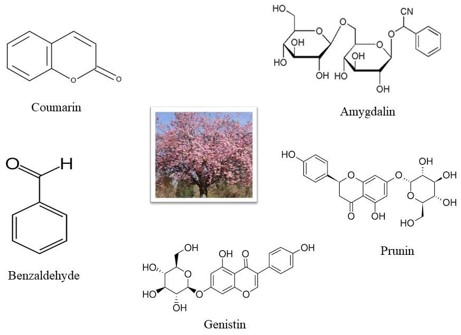
There are many other countries where cherry blossom trees are found which people use in various works. Cherry blossom is a good medicinal source. Cherry blossom is an important plant for china and japan. Potential bioactive primary and secondary metabolites present in figure 2.
Oriental medicine has a long history dating back more than two millennia, having originated in China. Large trees of the Prunus serrulata var. spontanea L. (Rosaceae) family are extensively found in Japan and Korea. This tree’s edible fruits are used as an emmenagogue and in traditional medicine to treat mastitis, dropsy, and heart failure. Pruni cortex, a combination of P. serrulata, P. yedoensis, and P. sargentii, has been used in traditional Korean medicine as an antitussive, for relaxing, and for cleansing [67,68].
Antioxidative and antiviral activity
Numerous fruits’ phenolic components are well-known to be effective antioxidants that protect cells. The antiviral and antioxidant characteristics of four flowering cherry cultivars in Korea—Prunus yedoensis, Prunus sargentii, Prunus lannesiana, and Prunus cerasus—were examined in this study. Specific activities such as the hydroxy radical scavenging activity of 2,2-diphenyl-1-picrylhydrazyl (DPPH), the ability to reduce power, and the activity similar to Superoxide Dismutase (SOD) were measured for the antioxidant property. Furthermore, antiviral activity was assessed using inhibition tests conducted on the Pig Epidemic Diarrhoea Virus (PEDV) infection cycle. The antiviral activity was quantified as the lowest dose of cherry extracts that prevented 50% of the PEDV Cytopathic Effect (CPE). According to our findings, all four cherry types have significantly higher levels of antioxidants and antiviral properties. P. cerasus in particular has stronger antiviral and antioxidant properties [69].
Antioxidative and anticancer activity
Cherry (Prunus serrulata var. spontanea) flowers were extracted using organic solvents (methanol, ethanol, and acetone) and water, and the extracts’ antioxidant properties were assessed. The maximum total phenol concentration (104.30 microM), radical scavenging activity (34.2%), and reducing power (0.391) were observed in methanolic CBE (100 microg/ml). The Comet test was used to assess the impact of CBE on DNA damage caused by H(2)O(2) in human leukocytes. DNA damage generated by 200 microM of H(2)O(2) was potently inhibited by all forms of CBE, with methanolic CBE exhibiting the most inhibitory activity. This effect was dose dependant [70].
Culinary use
In China and Japan, cherry blossoms and leaves are utilised as culinary ingredients since they are edible:
Sakurayu, or salt-pickled blossoms in hot water, are served instead of green tea during celebratory occasions like weddings.
Sakura mochi is made from pickled leaves, which are mainly from the Ōshima cherry because to their softness, in salted water.
The blooms are used to extract flavour from wagashi, a traditional Japanese dessert, or anpan, a Japanese sweet bun that is typically filled with red bean paste. The blossoms are pickled in salt and umezu (ume vinegar).
The fruit, known as sakuranbo (桜悍坊), is tiny and primarily consists of a seed. Sakuranbo should not be consumed fresh or whole due to their bitter flavour; instead, the seed within should be removed and the fruit processed into preserves. Japanese Roku gin uses cherry blossoms as a botanical flavouring.
Alternative treatment options that are less expensive, safer, and more effective have been required due to public concerns about the efficacy and safety of currently available contemporary medicine. P. serrulata is used in Chinese traditional medicine, and it is believed that the plant’s potential therapeutic benefits against a variety of illnesses stem from the presence of many bioactive compounds. The most recent advancements in the use of P. serrulata and its secondary metabolites to treat a range of acute and chronic illnesses are discussed in this study. Like the majority of other medicinal plants, P. serrulata has a wide range of chemical components, including polysaccharides, alkaloids, steroids, flavonoids, and diterpenoids. Thus, herbal remedies—among which P. serrulata is one—are thought of as multi-target agents that carry out their therapeutic role more thoroughly. The many metabolites found in plants are very valuable in the future and have not yet been the subject of any kind of study. This analysis of plants serves as a foundation for numerous future studies and is significant to the Chinese medical system in addition to other global medical systems. Although there are many significant medicinal herbs in the Chinese system, P. serrulata is the most helpful and advantageous plant; however, more study is required.
Future prospects
P. serrulata is a plant that contains several primary and secondary metabolites that are used to treat both acute and chronic conditions; as a result, many pharmacological activities of the plant are yet unknown. For the greatest plant investigation, those tasks might be easy for new researchers to understand. P. serrulata contains a wide range of phytochemicals that have been discovered; these compounds may one day be used to cure illnesses and open up new research avenues.
Rishabh Gaur: Writing – review & editing, Writing – original draft, Conceptualization, Formal analysis.
Competing interests: Author has no competing interests to declare regarding the publication of this paper.
Funding support: None.